
The Nutrition Star
See this Open Evidence link to see how The Nutrition Star, along with its companion implementation program, SLIM TLC, compares to other diets, including The USDAs New Pyramid. Nonetheless, because of its flexibility, you can (should) adapt The Nutrition Star to any diet you prefer, and still use SLIM TLC to implement it – and also help you make all the other Therapeutic Lifestyle Changes needed to achieve your goals.
The Nutrition Star is a dietary guideline created by Douglas M. Cluff, M.D. to meet the desperate need for simplicity and livability in the world of nutrition and weight loss. He considers it to provide the magical intersection between what’s Effective, Livable, and Flexible (“The Magic ELF”) – and it is adaptable to about any eating preference! We invite individuals and industry alike to strongly consider its rational application to lifestyle and weight loss efforts. In his words…
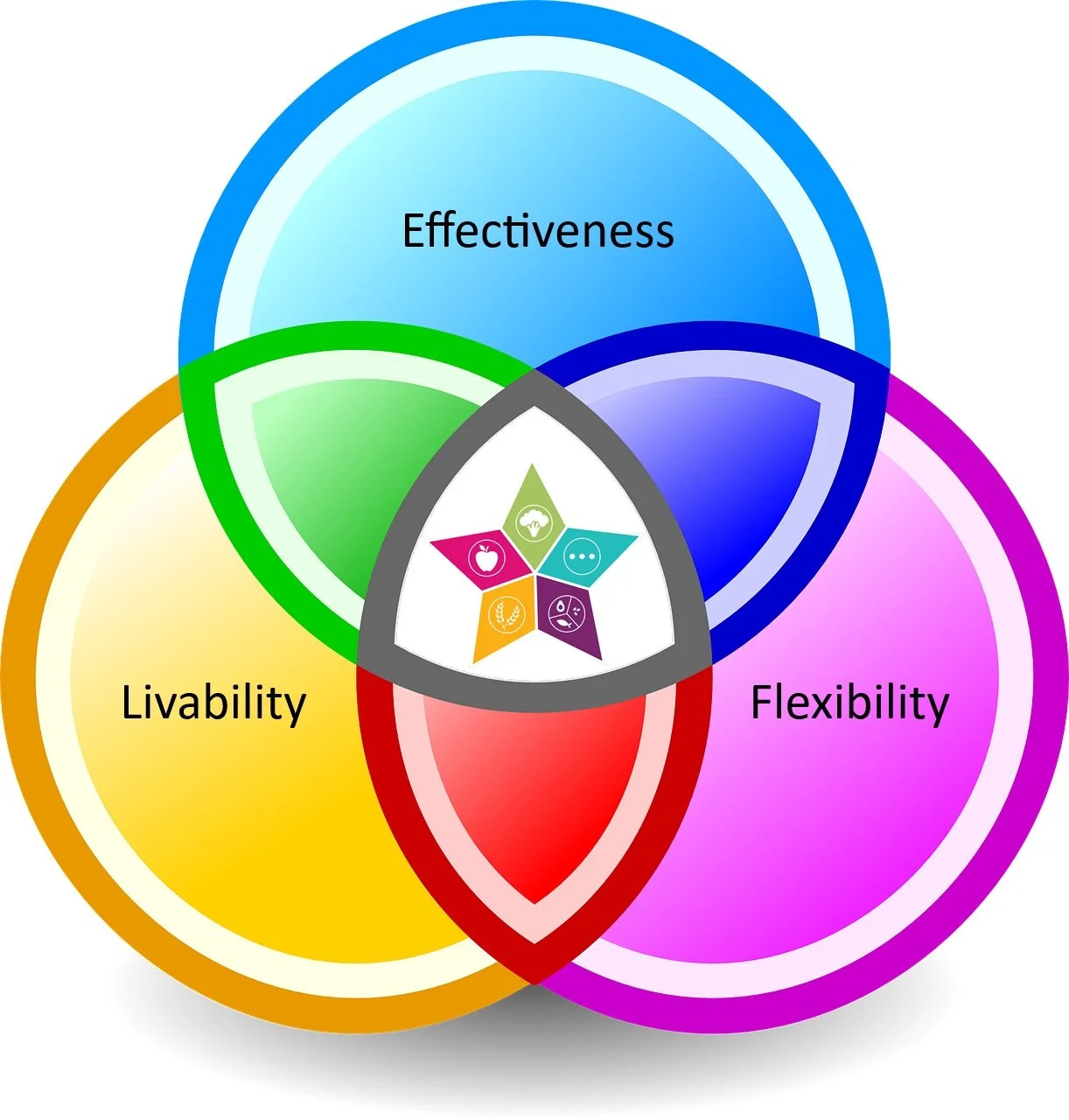
The Nutrition Star and 4◊Foods
If you were to ask a thousand health care professionals about nutrition and weight loss, you may get a thousand different answers. Opinion is the average of messages received (all of us are victims) – so the more one pursues a line of thinking that seems right (or attractive, perhaps because of addictions or philosophy), the more one will believe it. In fact, I’ve often likened nutrition to religion – once one has done research and drawn an informed conclusion, it’s next to impossible to change one’s mind. However, let me present my case.
A reasonable place to start a discussion of nutrition is with what most call (America’s) “government guidelines” (the Dietary Guidelines for Americans), previously called “My Plate,” but now called The New Pyramid (just came out in early January 2026; links to MyPlate pages are slowly being replaced by The New Pyramid pages):

MyPlate represented about a 70% plant-based diet. But there was a lot of allowance for processed foods, which are not healthy.
The New Pyramid also represents about a 70% plant-based diet, but the big difference is that it highlights the need to make the plants WHOLE (= contains the original nutrients, water, and fiber – nothing being processed out). BIG fan. In other words:
The New Pyramid represents about a 70% whole plant-based diet.
MyPlate seemed to emphasize whole only about half the time.
Do I agree with these latest USDA guidelines? Mostly.
In 2012 I began to learn about and see the power of a whole plant-based (WPB*) in my patients. I repeatedly witnessed amazing cases of weight loss and reversal of diabetes, hypertension, hypercholesterolemia, erectile dysfunction, and constipation, in addition to elusive improvement in energy, endurance, and mood.
Several things, however, made me lean away from recommending a 100% WPB diet, including:
Almost all my patients (including me) were unable or unwilling to sustain it long-term, thus reversing the miraculous changes we saw.
Besides highlighting the significant medical benefits, vegan and vegetarian philosophy is frequently discussed, and often promoted, in seminars and literature extolling the virtues of a WPB diet (thus introducing bias; although it’s foolish to conclude that vegans and vegetarians aren’t far healthier than those on the SAD – Standard American Diet – and others).
For those of us who choose to allow a little of the less-healthy stuff, as long as we overwhelm it with a much larger quantity of very healthy foods, we will likely see little harm (I recognize that is a very bold statement, and must be understood in context – especially depending on the situation and what medical conditions are in play). As the saying goes, “Perfection is the enemy of the good.”
After many iterations, I now recommend…
The Nutrition Star

The Nutrition Star also represents about a 70% whole plant- and fatty seafood-based diet, with another 10-15% coming from lean meats and low-fat dairy – but there are key differences between The Nutrition Star and The New Pyramid. The Nutrition Star:
Recommends getting about half your protein from plants, which have:
o A much lower caloric density than animal products (= better weight management).
o A much higher micronutrient content than animal products (= better health).
o Fiber (animal products have no fiber).
Recommends fatty seafood as a significant source of animal protein, which has primarily good instead of bad fats, yet not prohibiting other sources of animal protein.
Focuses more on flexibility, which increases long-term livability.
Focuses more on weight management.
The Nutrition Star, as you already learned, consists of five sections, called “diamonds:”
(Whole) Fruits
(Whole) Vegetables
Whole Grains
High-Quality Protein and Good Fats
Whatever!
For those who desire, the Nutrition Star can be adapted into a diet that is 100% W(F)PB and vegan/vegetarian (V/V) friendly, since you can leave animal products out of both the High-Quality Protein and Good Fats and Whatever! sections – hopefully filling them with life-giving whole plants (and, for vegetarians, including dairy in the Whatever! section). I do appreciate and agree with what it says about Vegetarians and Vegans in the new Dietary Guidelines for Americans (see the last page).
Of the more well-known diets, the diet that most closely resembles the Nutrition Star is probably the Mediterranean diet, the differences including that I categorize all oils except for two tablespoons of extra-virgin olive oil (EVOO), any dairy or cheese above certain daily amounts (see below), and all alcohol as Whatever! (and yet, it is critical to understand, they are not by any means prohibited – simply limited and not promoted as healthy). However, I posit that The Nutrition Star may outperform the Mediterranean diet in health/disease reversal and weight management – at least theoretically, supported by Open Evidence, the legitimate medical AI tool. See my Nutrition Star vs. Mediterranean Diet for health/disease reversal and weight loss debate from a search performed January 16, 2026.
Summary of the Nutrition Star Guidelines
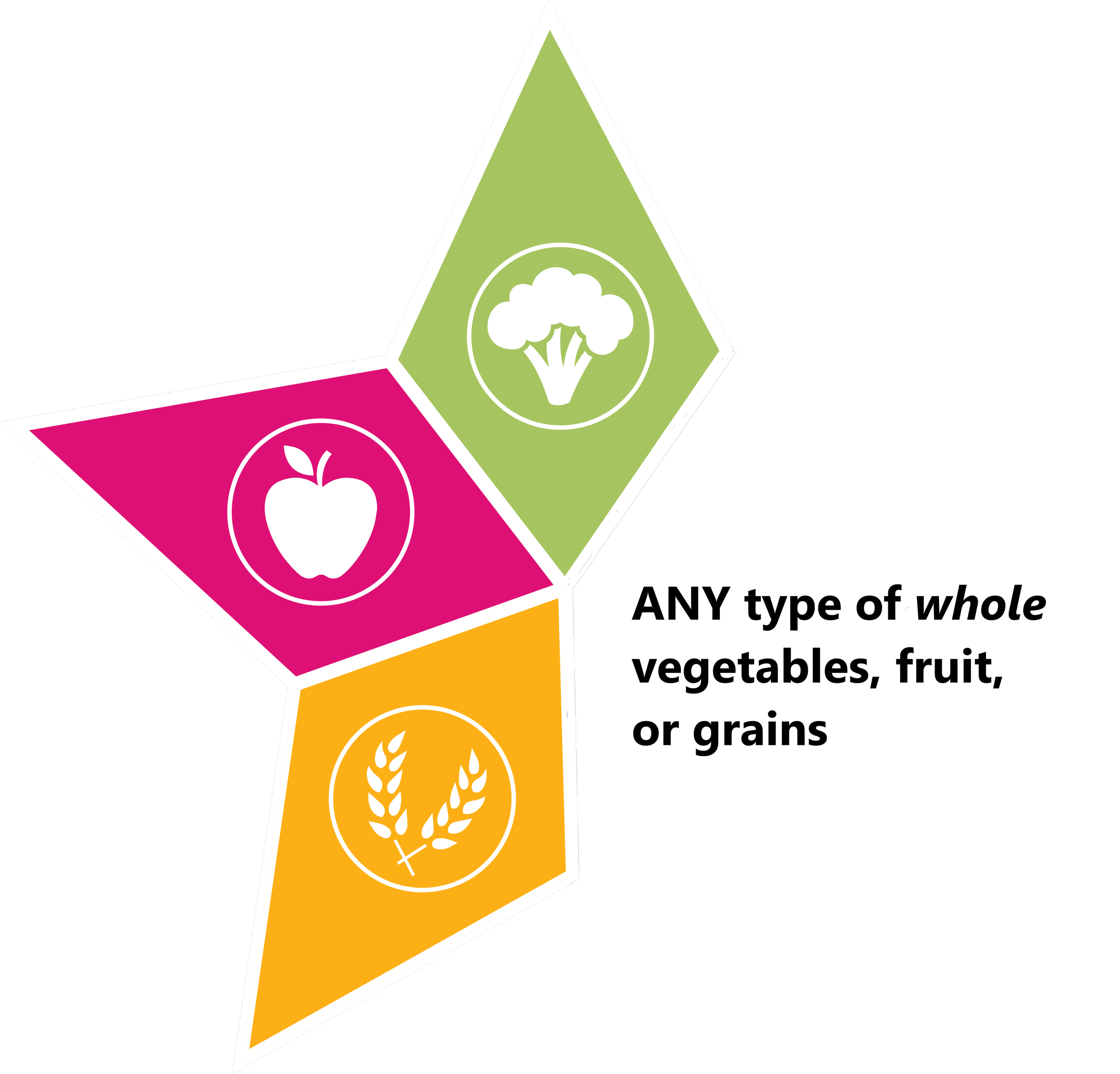
The Vegetables, Fruit, and Whole Grains diamonds include ANY type of whole (non-processed, meaning all the original nutrients and fiber are preserved) vegetables, fruits, or grains.
It’s always wise to try to get a good variety, for a variety of reasons – however, for simplicity’s sake (i.e. livability), and because I have found strong evidence that it does not matter that much from a health standpoint, I do not recommend stressing too much about which plant to choose within each category.
It is true that certain fruits (especially berries) have more micronutrients than others, but the more restrictions you place on your diet, the less likely you’ll be able to sustain it. And for those who think too many fruits of any type raise your blood sugar so aren’t good for you, for your sake (health) and to increase your chances of sustaining the diet, while actually improving blood sugar management, do not limit fruits because you’re worried about the sugar! See (likely) proof of this from Open Evidence, queried on December 19, 2025.
As long you use the whole plant, and it is prepared healthily, ¡buen provecho!
Another example is potatoes. They are packed with nutrition, but most people associate them with poor health. However, any poor health that might result from eating potatoes has nothing to do with the potatoes themselves, and everything to do with how they are prepared (50% of potatoes consumed in America are deep-fried, and most of the rest are smothered with Whatever! – see below). If you bake them with a little spray butter and seasoning, or air-fry them, the more you eat, the better!
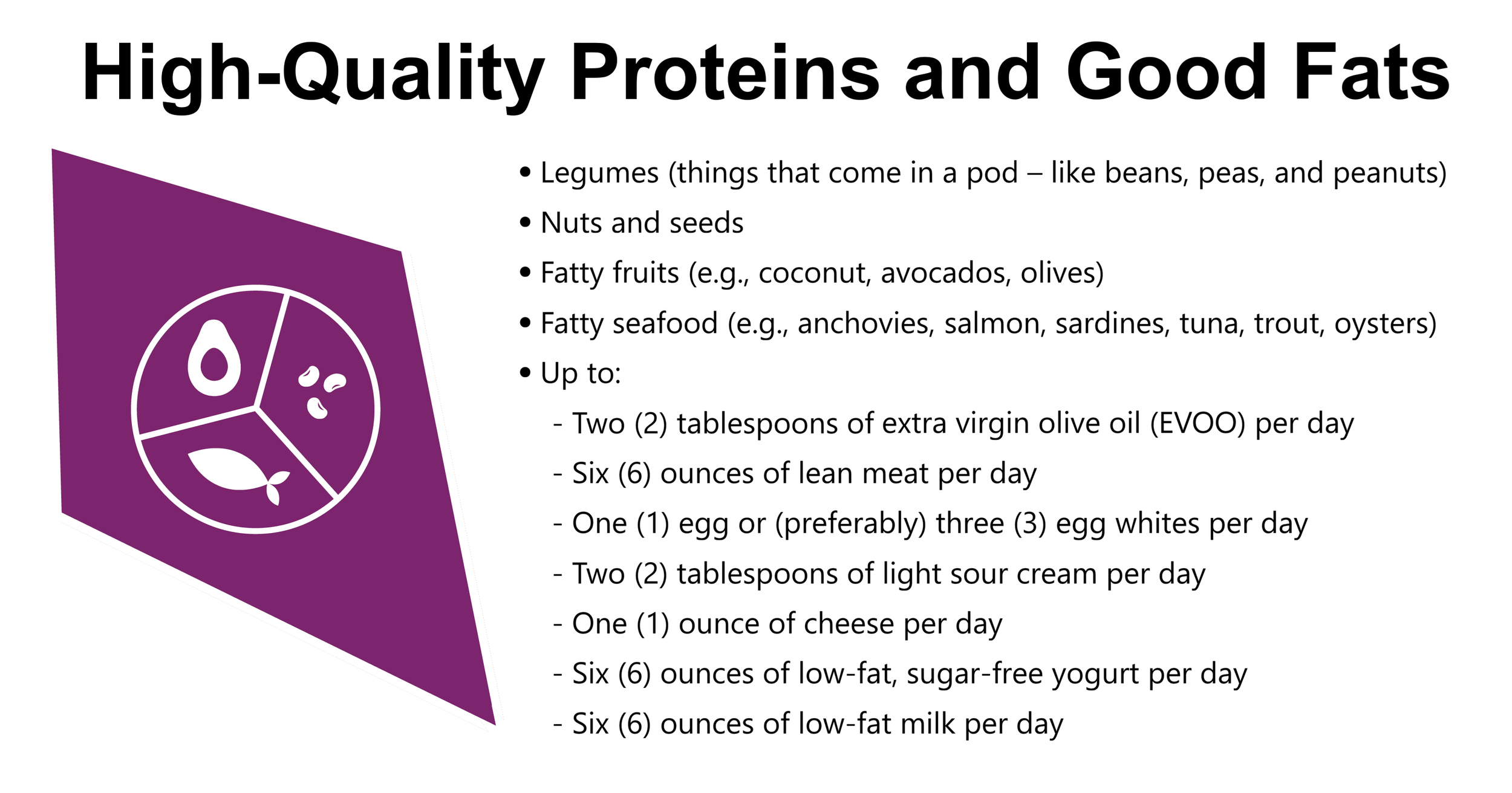
The High Quality Protein and Good Fats section includes:
Legumes (things that come in a pod – like beans, peas, lentils and peanuts)
Nuts and seeds
Fatty fruits (e.g., coconut, avocados, olives)
Fatty seafood (e.g., anchovies, herring, mackerel, salmon, sardines, tuna, trout, oysters)
Up to:
Two (2) tablespoons of extra virgin olive oil (EVOO) per day
Six (6) ounces of lean meat (no visible fat, or <10% fat) per day (can include non-fatty seafood)
One (1) egg or (preferably) three (3) egg whites per day
Two (2) tablespoons of light sour cream per day
One (1) ounce of cheese per day
Six (6) ounces of low-fat, sugar-free yogurt per day
Six (6) ounces of low-fat milk per day
“Lean meat” is defined as having no visible fat, but specifically:
Beef or ham/pork with <10% fat (10 or fewer grams of fat per 100 g or 3.5 oz) and no visible fat
Chicken or turkey breast that is skinless and has no visible fat (preferred source)
Non-fatty seafood (including shrimp, crab, lobster, oysters)
Together, the above Four Diamonds of the Nutrition Star make up the 4♦️Foods.
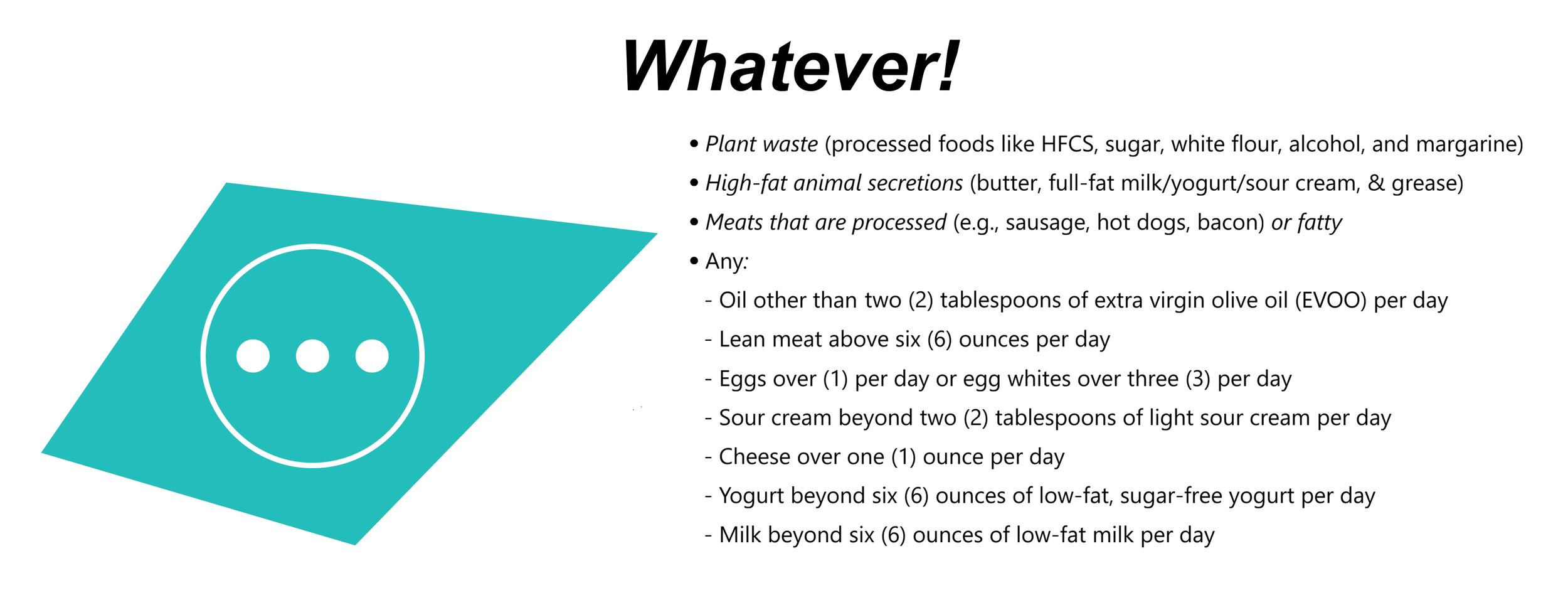
The Whatever! section includes…to repeat, WHATEVER!, but generally refers to anything that is more counterproductive than not to our goals of health and/or weight loss:
Plant waste. This is a term I use to describe all plant products that have had all (or almost all) of the nutritious components and fiber processed out, e.g., high-fructose corn syrup, sugar, white flour, alcohol, margarine, and oil (but note the exception of allowing up to two tablespoons of extra-virgin olive oil/day).
High-fat animal secretions. This includes high-fat dairy (butter, full-fat milk, yogurt, and sour cream) and grease (meat drippings).
Meats that are processed (e.g., sausage, hot dogs, bacon) or fatty (>10%, or if visible/marbled; includes non-white chicken)
Any:
Oil other than two (2) tablespoons of extra virgin olive oil (EVOO) per day
Lean meat above six (6) ounces per day
Eggs over (1) per day or egg whites over three (3) per day (see an exploration of the egg debate in Open Evidence, performed on September 6, 2025)
Sour cream beyond two (2) tablespoons of light sour cream per day
Cheese over one (1) ounce per day
Yogurt beyond six (6) ounces of low-fat, sugar-free yogurt per day
Milk beyond six (6) ounces of low-fat milk per day
Whatever! foods are more counterproductive to our goals of health and/or weight loss than not because they are either 1) lower in (or have no) nutrient density, 2) high in bad fats and/or caloric density, 3) too addictive (and therefore cause you to crave and eat more), and/or 4) their potential harms outweigh their potential benefits.
Whatever! Items (Mostly) Highlighted on The New Pyramid
The New Pyramid, since it recommends whole foods, most of it aligns with recommendations from The Nutrition Star. But several things, if you eat more than a little, fall into the Whatever! Diamond – and they are circled below:

Since you are now a Nutrition Star master, you know that there are small allowances of:
Lean meat (the cut of meat pictured is fatty, as is brown meat from poultry, but poultry breast, without visible fat, is lean; the hamburger must be ≥90% fat-free to qualify): Up to six (6) ounces/day
Cheese: Up to one (1) ounce/day
Eggs: Up to one (1) whole egg or three (3) egg whites/day
Extra virgin olive oil: Up to two (2) tablespoons/day
Dairy: Up to two (2) tablespoons of light sour cream/day, six (6) ounces of low-fat, sugar-free yogurt per day, and six (6) ounces of low-fat milk per day
But all butter, whole milk, and non-low-fat, sugar-free yogurt are Whatever! – why? Evidence has long shown that saturated fat is unhealthy, although some recent evidence is calling that into question. However, I still categorize them as Whatever! because my program is also about losing weight – and these are high in fat, which contains nine (9) calories per gram.
Is All Whatever! The Same?
Hopefully you have noticed that some Whatever! foods are worse than others – but what they have in common is that they are more counterproductive to our goals of health and/or weight loss than not. Why? Because they are either 1) lower in (or have no) nutrient density, 2) high in bad fats and/or caloric density, 3) too addictive (and therefore cause you to crave and eat more), and/or 4) their potential harms outweigh their potential benefits.
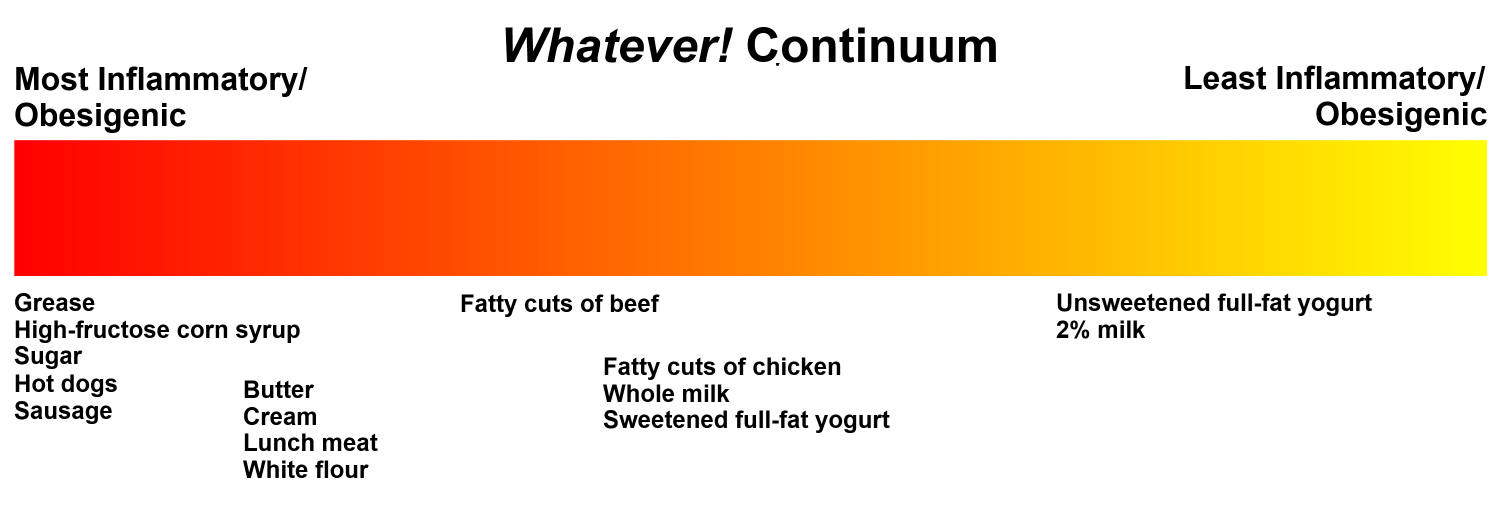
Wait – you are banning all Whatever!?
You are missing the point of Whatever!! The Nutrition Star doesn’t ban anything and allows everything. It simply discourages and encourages some things more than others – sometimes strongly, and sometimes weakly. Again, based on your preferences and strong feelings, you can fill Whatever! with…WHATEVER!
Hidden Calories and Inflammation
A critical point to make is that Whatever! foods are responsible for the grand majority of hidden calories and inflammation. Unless you make food yourself (or watch it being made), it is rarely “WYSIWYG” (a term you’ll know if you’re old enough, used in computing: What You See Is What You Get). Despite nutrition labels and lists of ingredients, you have no idea how much certain types of plant waste (primarily sugar and oil) and animal secretions (primarily cream, butter and grease) are truly present, as they are often or almost always invisible to the naked eye – especially in restaurants, where they only list the ingredients you see. Indeed, what’s hidden or unclear are among the most addicting, inflammatory (disease-causing), and/or obesogenic (obesity-causing) parts of the meal!
Important points to remember:
Do your very best to satisfy your sweet tooth with whole fruit instead of sugar.
Artificial or processed plant-based sweeteners/syrup/honey, including things sweetened by them, are not 4♦️Foods. I recommend sweetening things as above. We’re trying to break addictions, and just like sugar, artificial and processed plant-based sweeteners perpetuate one’s addictions to sweets. Some argue, “What’s healthier – sodas sweetened with sugar or artificial sweeteners?” Truth be told, the latter, but just because artificial sweeteners are calorie-free, it doesn’t mean they are healthy, for various reasons, especially when they are used to create drinks that contain caffeine. How productive can it be to have two addictive substances in sodas? Drink water instead, whenever possible.
To make foods creamier, try using puréed cashews (which are especially great for salad dressings and plant-based sour cream!) or other nuts, seeds, potatoes, or zucchini. Oat milk may also help.
Whole herbs, spices, and low-calorie plant products (e.g., soy sauce and plant-based milk – excluding coconut milk, which is not low-calorie) are considered 4♦️Foods and can be used at will. Of the plant-based milk options, I strongly recommend pea or soy milk, because of the protein content.
I am comfortable with you using spray butter instead of butter and margarine, although if you are vegan, know that spray butter is made from milk products.
Oils: Oils of any type are processed foods (out of plants) – devoid of water, fiber, and almost all micronutrients. They provide nature’s most efficient way to store fuel, thus increasing the risk of weight gain (imparting nine calories per gram). Therefore, consuming too much of any type causes more harm than good (although remember that up to two tablespoons of extra-virgin olive oil/EVOO per day is included in the High-Quality Protein and Good Fats diamond). Don’t confuse the fats in plants (= good for you!) as being synonymous with oils. They aren’t actually “oils” until they are processed out of the plants. Instead of consuming them, oils should be used on the outside of the body – for conditioning, moisturizing, and lubricating. The moral of the story is: eat the whole olive. If you don’t think you can cook anything (or most things) without oil, think:
Grill
Steam
Bake
Boil
Broil
Roast
Microwave
You can also sauté using non-stick spray and/or vegetable broth (or the two tablespoons of EVOO). If desired, you may watch a debate about whether or not olive oil is good for you here: https://www.youtube.com/watch?v=gYj_NqVTvi4. Also see the results of the brief research I did (Christmas Day, 2025) in Open Evidence (medical artificial intelligence tool), comparing the benefits of olive oil vs. eating whole fatty plants: https://www.openevidence.com/ask/16eb8fd5-f955-4d99-8817-d165ded9bf39.
The internet is full of ideas and recipes that are oil- and/or sugar-free.
FAQs (Frequently-Asked Questions)
What if I am a strong believer in a 100% Whole (or Whole-Foods) Plant-Based [or “W(F)PB”] diet?
If you are what I call a “healthy vegan,” and believe that a diet consisting only of whole plants is the pathway to ultimate health, longevity, function, and weight management, I cannot disagree with you – if you are able to follow it faithfully. A mentioned above, you, too, can follow the Nutrition Star, filling the High-Quality Protein and Good Fats section only with whole plants like nuts, seeds, legumes (especially edamame), olives, avocados, and coconut; and you’d fill the Whatever! section with your choice of whole plants! I, too, believe in the power of whole plants. However, I believe that as long as >80-90% of your calories (not volume) come from whole plants, the sheer micronutrient, phytochemical, anti-inflammatory power of a variety of whole plants will help your body neutralize the other 10-20%. As such, I counsel WPB proponents who struggle to follow a 100% WPB diet that it is likely OK to indulge a little bit.
Who cut the cheese?
I categorize excess cheese (above one ounce per day) as Whatever! because of the 1) high caloric density, 2) saturated fats, and 3) addictive nature. Cheese is made of high-fat, concentrated processed milk, and some would argue that milk by itself already helps to turn calves into cows.
Would you please remind me of your thoughts about vegans and vegetarians?
As I suggested above, vegans and vegetarians (V/V) are usually far healthier and slimmer than the average SAD (standard American diet) consumer. Most V/V are V/V because of philosophical or religious reasons; few do it only for health reasons, but most do it for a combination of the above. However, by definition, since vegans can eat anything from a plant (including plant waste), and, by definition, vegetarians can eat plant waste AND any type of dairy (including ice cream and lots of cheese), being vegan or vegetarian is not always synonymous with good health and weight management. For example, I’ve known morbidly obese vegan patients who are every bit as unhealthy and addicted to plant waste (e.g., French Fries, sugar, Oreo Cookies) as the average Joe. As such, I try to leave the “V” words out of the health discussion and instead recommend putting the two Vs together to get a “W” (for Whole, not “Whatever!”). Whether you are a plant-based proponent for health, philosophical, or religious reasons, always try to keep your plants whole.
Do I have to go (actually) hungry to lose weight?
NO, because when you eat right (4♦️Foods, with their low caloric density and being devoid of hidden calories), you get to eat a lot more food, without gaining weight! Plus, the fiber contained in whole plants, combined with the fats and proteins in the High-Quality Protein and Good Fats Diamond, increase satiety.
In addition, it is estimated that nearly 1/4th (23%) of the complex carbohydrate calories in the whole plants you eat are burned up as your body tries to turn it into fat. When I first learned about or realized this, which essentially gave me permission to eat whenever I was (“actually”) hungry, I was hooked – for life. Like you, I love to eat, and until I learned these dynamics, eating was not as enjoyable, always seeming to be counterproductive to my weight loss goals. Not anymore!
Low-Carb vs. Low-Fat
First of all, please quit using the term “low-carb” and instead use “low-simple carb,” even if you limit some plants – you aren’t limiting all plants, are you, which are carbs (complex)?
Many, if not most, so-called low-carb and/or high-protein proponents will take one look at The Nutrition Star and immediately conclude that it promotes a high-carb, low-protein diet, and therefore immediately dismiss it. If you have done that, not only are you missing the point, but you will miss out on the amazing benefits, and engaging in nutrient displacement (all the other micronutrients you aren’t getting from the rest of the whole plant). You will have also misinterpreted the Nutrition Star. It is a low-simple carb, low fat (healthy)-animal protein (and high-fatty seafood), low-oil diet. As such, may I offer you a hearty invitation (e.g., strongly encourage you) to reconsider?
Remember that The Nutrition Star can be customized to fit your preferences, unlike (almost) any other diet, made possible by the Whatever! (flexibility and livability) Diamond. There are plenty of options for you. “Low-carb” and/or high-protein proponents may happily eat all the high-protein and high-fat plants and fatty seafood they want, filling the High-Quality Protein and Good Fats section with plenty of nuts, seeds, legumes, avocados, and fatty seafood, and smaller amounts of other animal protein as outlined above (although I encourage trying to get half of your protein and most of your food volume from plants). Then, only if they feel the foregoing doesn’t provide enough protein or fat, they can fill the Whatever! section with their preferred additional animal products and oil (preferably EVOO). Other 4♦️Foods can include non-starchy vegetables and lower-carb fruits.
Nutrition Labels
In January 2018 the U.S. Food and Drug Administration released its new-and-improved Nutrition Facts label, which has begun to appear on some products. Manufacturers with $10 million or more in annual sales were supposed to start using the new label by January 1, 2020, and manufacturers with less than $10 million in annual food sales had until January 1, 2021 to comply.* I feel it’s a good step in the right direction, since it now clearly identifies the grams of added sugar (yummy, but a plant waste).
If you have read the section above about Low-Carb vs. Low-Fat, however, you would understand how I might be highly disappointed that the new label does not do anything to distinguish between good and bad fats. Hopefully it won’t take decades before that change occurs. For now, we are stuck reading the ingredients and trying to guess – which is very difficult when products contain both oil (bad fat, a plant waste) and good fats, like nuts and seeds. It also does not distinguish between good and bad types of cholesterol (HDL, or high-density lipoprotein, which protects against heart disease, vs. LDL, or low-density lipoprotein, which contributes to the development of heart disease).
In addition, the listing of vitamins or added fiber present can either give you a false sense of nutritional value or ignore the fact that there are likely hundreds, if not thousands, of other ignored or yet undiscovered micronutrients contained in whole plant foods. It would also be nice to know the source of the protein, i.e., animal- vs. plant-based. The reality (and good news) is that the more you move towards a diet of predominantly healthily-prepared plant- and fatty seafood-based foods, the less you have to worry about labels.
Salt (Sodium)
I learned in medical school that a significant portion of the population has adequate mechanisms in place (well-functioning kidneys) to handle a fair amount of salt, and although a lot has changed since then, over the years the debate has not been settled. The problem is that we don’t have a great way of predicting who can and who cannot tolerate a lot of salt. As such, it is wise to do your best to avoid excessive salt, and follow the guidelines on product labels (see the “% daily value” column on the right – I agree with looking at that) – especially if you have found that you are sensitive to salt (blood pressure goes up, fluid collects in your lower legs, etc.) or are at high risk (personal or strong family history of high blood pressure, heart disease, diabetes, etc.). It is also my very strong opinion that what you put the salt on is far more important than whether or not you use salt (in other words, it’s the “fry” in French fry that hurts you, not the salt on it). If nothing else will make you eat broccoli and other vegetables, for Pete’s sake, add some salt! Consider reading Dr. John McDougall’s take on it.
*What I call a WPB diet is usually referenced by others as a “WFPB” or whole-foods plant-based diet. I just don’t see any great value in adding the F word.
**Changes to the Nutrition Facts Label, U.S. Drug and Food Administration website, accessed July 16, 2019 at https://www.fda.gov/food/food-labeling-nutrition/changes-nutrition-facts-label